
Most trekkers finish Langtang Trek and realize the same thing a little too late – the main trail is only part of the experience. The best Side Trips & Extensions Langtang Trek options can turn a good itinerary into a far more rewarding one, whether you want better mountain views, more acclimatization time, cultural depth, or a longer journey into nearby valleys.
Langtang is one of Nepal’s most flexible trekking regions. The standard route to Kyanjin Gompa is already excellent, but it also gives you room to customize without the scale, cost, or time commitment of some larger Himalayan circuits. That matters if you want something more than a simple in-and-out trek, but still need a route that is realistic to plan.
The right extension depends on what kind of trekker you are. Some side trips add only a few hours and give a big visual reward. Others add several days and change the character of the whole journey. What follows is a practical look at the best options, what they add, and when they make sense.
Why add side trips to the Langtang trek?
The main Langtang Valley route is relatively straightforward. You walk from Syabrubesi or the road access point, pass through Lama Hotel and Langtang village, and reach Kyanjin Gompa. If you return the same way without variation, you still get a fine trek. But many trekkers have enough time and energy for more.
A side trip can improve the trek in three important ways. First, it gives you stronger mountain views than the valley trail alone. Second, it helps with acclimatization, especially if you use a higher viewpoint as a day hike before sleeping lower. Third, it adds variety. Langtang is not only about one valley floor. There are ridges, glaciers, yak pastures, sacred lakes, and passes that reveal a much broader landscape.
That said, more is not always better. If your fitness is average, your schedule is tight, or the weather is unstable, adding too much can make the trip rushed. In Langtang, a well-chosen extra day is usually better than forcing a long extension you are not prepared for.
Best short side trips on the Langtang trek
Kyanjin Ri
If you only add one side trip, Kyanjin Ri is usually the best choice. From Kyanjin Gompa, this is the classic viewpoint hike and the most popular reason trekkers spend an extra night there. The route is steep and demanding because of the altitude, but technically it is not difficult in normal conditions.
The reward is excellent. You get wide views over Langtang Lirung, the Kyanjin area, glaciers, and the surrounding peaks. For many trekkers, this becomes the visual highlight of the entire trek. Because you return to sleep at Kyanjin Gompa, it also works well from an acclimatization point of view.
Start early if the weather is clear in the morning. Afternoon cloud can hide the bigger views, and strong wind is common higher up. If you feel the altitude strongly in Kyanjin, do not force a full ascent. Even a partial climb gives good views.
Tserko Ri
Tserko Ri is the bigger and more strenuous alternative to Kyanjin Ri. It is higher, longer, and usually harder on the legs. For trekkers who are moving well at altitude, it offers one of the finest panoramas in the Langtang region.
This is often the better choice for strong hikers who want a full day objective rather than a shorter viewpoint walk. The mountain scenery is broader and the sense of scale is greater. But it should not be treated casually. An early start is important, and snow or ice can make the route more serious in colder months.
If your itinerary allows two nights in Kyanjin Gompa, some trekkers do Kyanjin Ri on one day and Tserko Ri on another. That works well for fit trekkers, but only if you are recovering well and not showing signs of altitude trouble.
Langshisha Kharka
Langshisha Kharka is less famous than the two Ri viewpoints, but it is a very worthwhile day trip from Kyanjin for trekkers who prefer a valley exploration over a steep summit push. The route follows the upper valley deeper into a wilder and more open landscape.
This trip gives a different feeling from Kyanjin Ri or Tserko Ri. Instead of a hard climb for a viewpoint, you get a quieter journey through yak grazing land and expansive terrain beneath high peaks. It suits trekkers who want a longer but less sharply uphill day.
It is also a good option if someone in your group wants an extra excursion but is not keen on steep ascents. The scenery is excellent, though the dramatic top-down panorama is replaced by a more immersive mountain valley experience.
Best longer extensions from Langtang
Gosaikunda extension
For many trekkers, the best full extension is to continue from Langtang toward Gosaikunda. This turns a valley trek into a more complete regional journey with alpine lakes, high ridges, and a stronger sense of progression.
Usually, this extension involves heading back toward the lower trail network and then continuing into the Gosainkunda area via Laurebina. The sacred lakes are the centerpiece, and in clear conditions the scenery is outstanding. The terrain and experience feel noticeably different from Langtang Valley, which is why this combination works so well.
The trade-off is effort. This is no longer a simple side trip. It adds multiple days, more ascent and descent, and more planning around overnight stops. It is best for trekkers who have at least a moderate level of fitness and enough spare days to avoid rushing.
Gosaikunda to Helambu
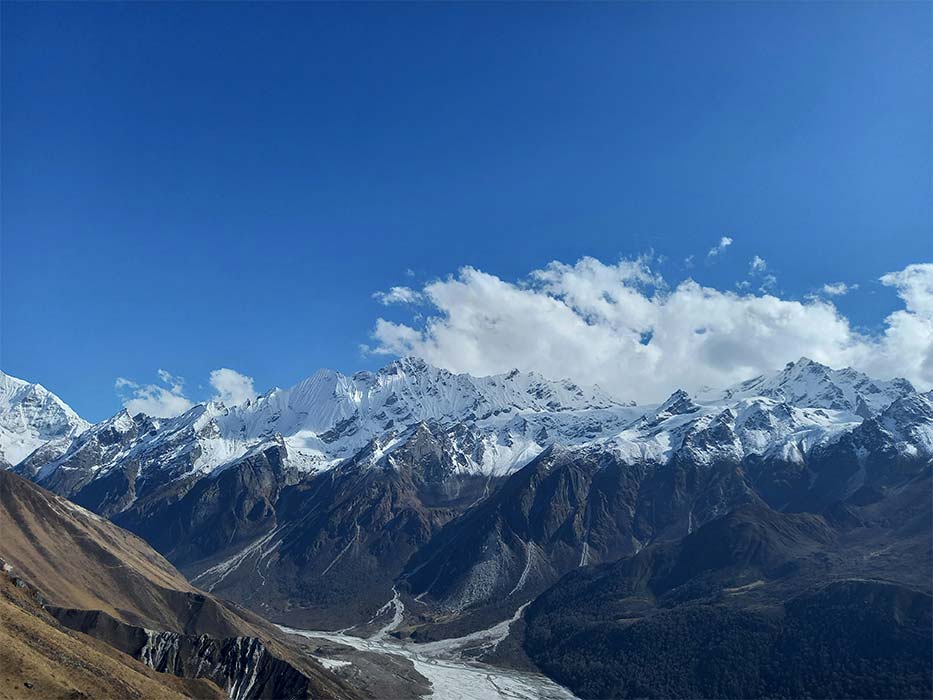
If you want a more substantial extension, continuing beyond Gosaikunda into Helambu creates a rewarding traverse rather than a return journey. This gives you a trek with greater landscape variation, from high alpine terrain near the lakes to lower hills, villages, and forests farther south.
This extension suits trekkers who prefer route diversity and dislike retracing steps. It also works well if you want a longer trek in the region without committing to a very remote or highly technical route. The cultural feel shifts gradually as you move into Helambu, which adds another layer to the experience.
The main thing to consider is time. A Langtang-Gosaikunda-Helambu trek needs a more comfortable itinerary than the standard Langtang route. Weather around Lauribina La can also affect the plan, especially in winter or after fresh snowfall.
Tamang Heritage Trail combination
Another smart extension is to combine Langtang Valley with the Tamang Heritage Trail. This is less about high viewpoints and more about adding village life, cultural context, and a different walking rhythm before or after the main valley trek.
This combination makes sense for trekkers who do not want every day to feel like a push toward altitude. The Tamang villages offer a more settled atmosphere, with terraced hillsides, local communities, and a chance to understand the region beyond the main trekking corridor.
It is especially useful if you are interested in culture as much as mountain scenery. The trails are generally lower than the upper Langtang section, so this can also be a practical way to lengthen the trip without spending all extra days at high elevation.
How to choose the right Langtang extension
Your best option depends on time, fitness, and what you want from the trek. If you only have one spare day, use it at Kyanjin Gompa and hike either Kyanjin Ri or Tserko Ri. That is the highest-value addition for most people.
If you have three to five extra days, Gosaikunda becomes realistic and adds real depth to the trek. If you have a week more than the standard itinerary, extending onward to Helambu can be a very satisfying plan. If your priority is culture and village experience, pairing Langtang with the Tamang Heritage Trail is often a better fit than chasing another high point.
There is also the question of season. In spring and autumn, most extensions are more straightforward. In winter, snow can complicate higher routes and passes. During the monsoon, trail conditions, landslides, and cloud can reduce the appeal of some side trips, especially the viewpoint hikes.
Practical planning tips for Side Trips & Extensions Langtang Trek
Build extra days into your itinerary from the start. Trying to decide on a major extension while already on the trail can work, but transport timing, weather, and energy levels often make last-minute changes less ideal.
Pay attention to altitude response before committing to the bigger side hikes. Kyanjin Ri and Tserko Ri are rewarding, but they are still high-altitude outings. If you arrive in Kyanjin with a headache, poor sleep, or loss of appetite, rest first and reassess.
For longer extensions, ask whether you want a loop, a crossing, or a return route. This affects logistics, transport, and how much backtracking you do. It also affects your budget and porter or guide planning.
A guide is not mandatory for every trekker in every section, but for route combinations and changing conditions, local support can make the journey smoother and safer. That is especially true if you are linking Langtang with Gosaikunda or Helambu and want realistic pacing based on trail conditions rather than guesswork.
The best Langtang itineraries are rarely the ones with the most distance. They are the ones with the right extra day in the right place, giving you time to see more, walk better, and enjoy the mountains without rushing past what makes this region special.

