
Few trekking regions in Nepal give you this much natural variety in such a short approach from Kathmandu. Nature and Wildlife Langtang National Park is one of the strongest reasons many trekkers choose Langtang Trek over busier routes. You are not only walking toward mountain views. You are moving through a protected Himalayan landscape of dense forest, river valleys, glacial terrain, high pastures, and habitat for rare wildlife.
For trekkers, this matters because Langtang is not just about reaching Kyanjin Gompa or climbing Tserko Ri. The trail itself is the experience. If you understand the park’s ecology before you go, you notice far more on the route and trek with better respect for the landscape.
Why Langtang National Park feels so different
Langtang National Park was established in 1976 and was Nepal’s first Himalayan national park. It covers a wide elevation range, and that is exactly why the scenery changes so quickly. In the lower sections, the trail passes through subtropical and temperate forests with oak, pine, maple, and rhododendron. Higher up, the terrain opens into alpine scrub, yak pasture, and rocky glacial valleys.
This transition is one of Langtang’s greatest strengths. On many treks, the environment changes gradually. In Langtang, the shift can feel dramatic within a few days of walking. That gives the trek a strong sense of progression, especially for travelers who want more than mountain panoramas.
The park also has cultural depth. Tamang communities live in and around the region, and traditional land use is still part of the landscape. That means the natural environment here is not separate from local life. Forests, grazing land, seasonal movement, and village life all connect.
Nature and Wildlife in Langtang National Park
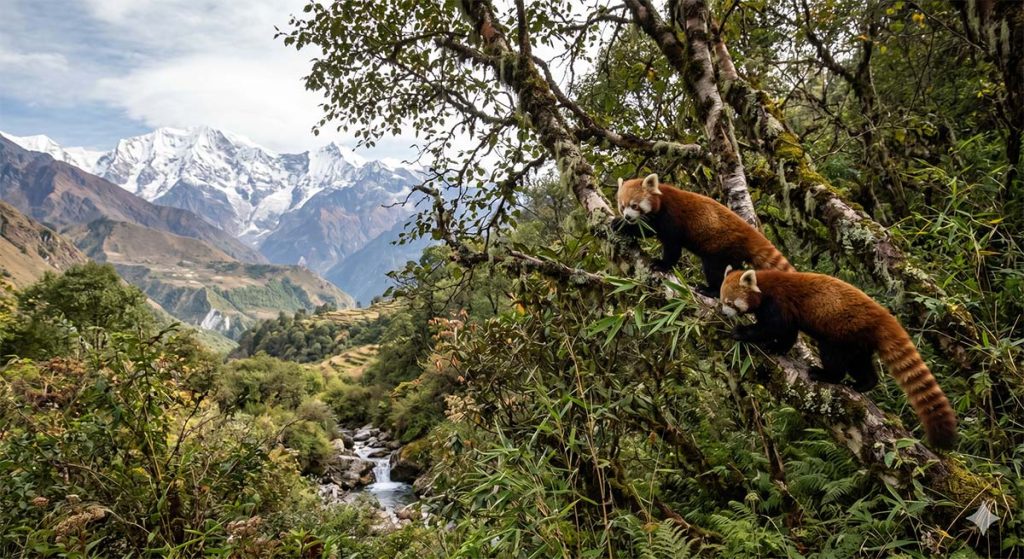
Wildlife sightings are never guaranteed, and trekkers should be realistic about that. The more popular the trail and the noisier the group, the lower the chance of seeing shy animals. Still, Langtang National Park supports some of Nepal’s most interesting mountain wildlife.
The species that gets the most attention is the red panda. It lives mainly in bamboo-rich temperate forest, and Langtang is one of the protected areas where suitable habitat remains. Seeing one is rare, but knowing you are trekking through red panda country adds another layer to the route.
Other wildlife in the park includes Himalayan black bear, musk deer, Himalayan tahr, goral, langur monkeys, and wild boar. In higher areas, snow leopard habitat exists, though actual sightings are exceptionally uncommon. Birdlife is also impressive, especially for trekkers who pay attention in the forest sections. Danphe, snow partridge, laughingthrushes, and eagles are among the species that may be seen depending on elevation and season.
If your goal is wildlife observation, early morning is usually the best time to stay alert. Quiet walking, avoiding loud music, and watching forest edges can make a difference. A guide with field experience can also help identify calls, tracks, and likely habitat that many trekkers would otherwise miss.
The main ecosystems trekkers pass through
One reason Langtang feels rich even on a relatively short itinerary is the variety of ecosystems packed into the route. From Syabrubesi upward, the trail follows river corridors and forested slopes where moisture supports thick vegetation. These lower and middle elevations are often where trekkers notice monkeys, birds, and dense rhododendron growth.
As you gain altitude, the forest begins to thin. Around Langtang Village and beyond, the valley becomes wider and more open. You start seeing juniper, dwarf shrubs, exposed slopes, and pastureland used by yaks. Near Kyanjin, the landscape turns almost stark in places, with glaciers, moraines, cold streams, and huge rock walls dominating the view.
This ecological range is part of what makes Langtang suitable for trekkers who want strong nature value without committing to a very long expedition-style trek.
Best season to experience the park’s natural side
Spring and autumn are the strongest seasons for most trekkers, but they offer different advantages. In spring, the forests are more colorful, especially when rhododendrons bloom. This is one of the best times to appreciate the lower and middle sections of the park, where plant life feels especially vibrant.
Autumn usually gives clearer mountain views and stable trekking conditions. If your priority is combining sharp Himalayan scenery with comfortable trail conditions, this is often the safer choice. Wildlife can be seen in either season, but visibility depends more on timing, silence, and luck than on any promise from the calendar.
Winter has a special beauty, especially in the upper valley, but cold temperatures and snow can limit comfort and route flexibility. Monsoon brings greener forests and fewer trekkers, yet leeches, cloud cover, and slippery trails make it less practical for most visitors.
How to trek responsibly in Langtang
A protected area stays healthy only if trekking pressure is managed carefully. In Langtang, that starts with simple behavior on the trail. Stay on established paths, avoid disturbing animals, and do not expect close wildlife encounters for photos. The right approach is patience, not pursuit.
Waste management matters as well. Carrying out non-biodegradable trash, reducing plastic use, and being thoughtful in teahouses all help. Water sources, grazing areas, and forests are part of both the ecosystem and local livelihoods.
Trekkers often focus only on permits, packing, and altitude. Those are essential, but respecting the park’s natural systems is also part of good preparation. Experienced local operators such as Himalaya Wanderer generally emphasize this because the quality of the trek depends on preserving the landscape people come to see.
What this means for your trek
If you are choosing Langtang, do not think of the national park as background scenery. It is the main character of the route. The forests below, the wildlife hidden in the slopes, the transition into alpine country, and the raw glacial terrain near Kyanjin are what give this trek its identity.
Go with realistic expectations. You may not see a red panda or a rare mountain mammal. But if you walk attentively, the park offers something just as rewarding – a clear sense of how Himalayan nature changes with altitude, weather, and human presence. That is what stays with many trekkers long after the trip ends.

