
Most trekkers come to Langtang for mountains, forests, and close-up Himalayan views. What stays with many of them, though, is the human side of the journey. Culture & People in the Langtang Valley are not a background detail to the trek – they are one of the main reasons the route feels distinct from Everest, Annapurna, or other busy regions of Nepal.
Langtang Trek is often described as one of Nepal’s most accessible treks from Kathmandu, but that short travel distance can create a false impression. This is not a quick scenic walk with a few villages along the way. It is a region with deep roots, strong community identity, Tibetan Buddhist influence, and a way of life shaped by altitude, trade, herding, farming, and resilience after hardship. If you understand a little of that before you go, the trek becomes richer and more respectful.
Who lives in the Langtang Valley?
The Langtang region is home mainly to Tamang communities, along with people whose culture, language, and religious practices show strong historical ties to Tibetan traditions. In the upper valley especially, that influence is easy to notice in dress, prayer flags, mani walls, chortens, monasteries, and the design of homes and lodges.
The Tamang are one of Nepal’s major ethnic groups, and in Langtang their identity is central to local life. Their history in the region is not just cultural but geographic. Communities developed in a high mountain environment where movement was difficult, seasons mattered heavily, and survival depended on local knowledge. That shaped everything from food habits to building styles.
For trekkers, this means the villages are not simply overnight stops. Places like Syabrubesi, Lama Hotel, Langtang Village, Mundu, and Kyanjin Gompa sit within a lived landscape. Families run teahouses, tend animals, work fields where possible, and maintain religious sites that are meaningful to daily life, not only to visitors.
Culture & People in the Langtang Valley today
One of the most important things to understand about Culture & People in the Langtang Valley is that tradition and change exist side by side. You may see yak herding, spinning prayer wheels, and stone houses that reflect long mountain traditions. At the same time, you will also find solar panels, mobile phones, trekking lodges with modern menus, and younger generations connected to tourism and education in new ways.
Tourism has become a significant part of the regional economy. Many local families depend partly or largely on trekking seasons through lodge operations, guiding, portering, transport support, and food supply. This does not mean traditional life has disappeared. It means village life has adapted. In practical terms, the valley is not frozen in time, and trekkers should avoid expecting a museum version of Himalayan culture.
That balance matters. Some travelers arrive hoping for a very remote cultural experience but are surprised to find Coca-Cola in a teahouse or Wi-Fi in certain villages. Others assume tourism has erased local identity. Neither view is accurate. Langtang remains culturally rich precisely because communities have continued to live, rebuild, adapt, and welcome visitors on their own terms.
Religion, monasteries, and everyday belief
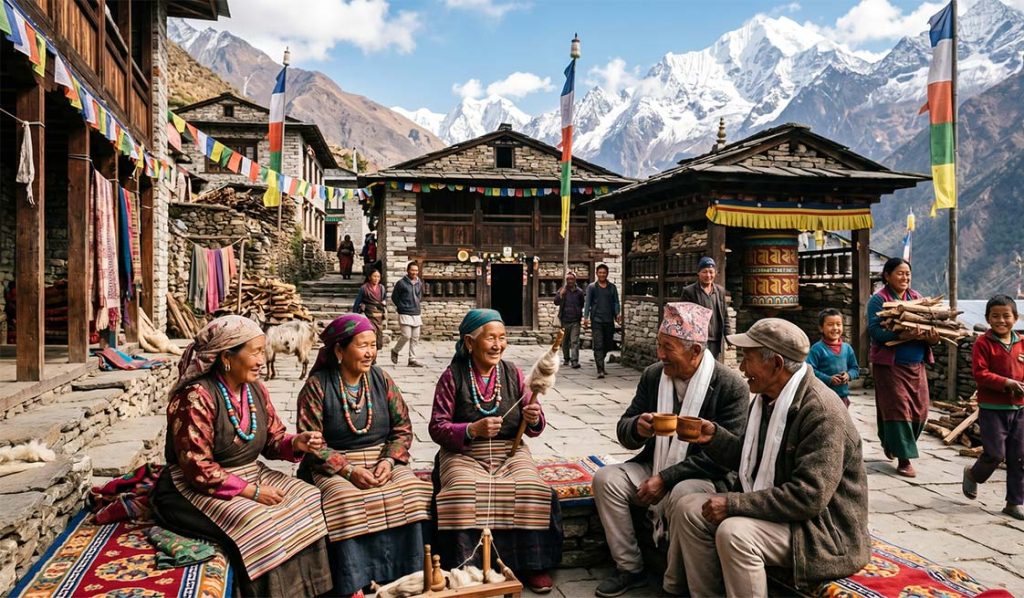
Buddhism shapes much of the visible spiritual life in Langtang. Prayer flags mark ridgelines and passes, mani stones line sections of trail, and chortens often stand at village entrances or important points along the route. Kyanjin Gompa is the best-known religious site for many trekkers, but spiritual practice is not limited to one monastery or one formal ritual.
In mountain communities, religion is woven into ordinary routines. People may offer prayers for safe travel, good weather, healthy livestock, and family well-being. Sacred symbols are not decorative features for tourists. They carry meaning, and that is why respectful behavior matters.
As a trekker, small actions make a difference. Walk clockwise around chortens and mani walls when the path allows. Ask before photographing monks, religious ceremonies, or private shrines. Dress modestly when entering monastery areas. These are simple habits, but they show that you are paying attention to where you are, not just passing through it.
Village life in a high mountain region
Life in Langtang has always been shaped by altitude and season. The higher you go, the narrower the range of practical choices becomes. Farming is limited by terrain and climate, so households have historically depended on mixed livelihoods that may include potatoes, barley, livestock, dairy, local trade, and now tourism.
Yaks and yak-crossbreeds remain an important part of mountain life, especially in upper areas. They support transport, milk production, cheese making, and local identity. Trekkers often think of yaks as part of the scenery, but for many families they are working animals and economic assets.
Homes and lodges are also built with climate in mind. Thick walls, compact rooms, central dining spaces, and practical layouts all reflect the need to manage cold conditions. What may feel simple to a visitor is usually the result of generations of adaptation to mountain realities.
This is also why expectations matter. Comfort in Langtang is improving, but this is still a trekking region where supplies come with effort, weather can disrupt plans, and daily life is harder than it appears from the dining room of a warm teahouse.
Food, hospitality, and what meals tell you
Food is one of the easiest ways to connect with local life. On the trail, dal bhat remains the classic trekking meal across Nepal, and in Langtang you will also find Tibetan bread, tsampa in some places, noodle soup, momos, potatoes, and yak cheese products, especially near Kyanjin.
The famous cheese from Kyanjin is more than a snack stop for trekkers. It reflects the valley’s long relationship with livestock and alpine production. That kind of local food tradition adds depth to the journey because it comes from the landscape itself.
Hospitality in Langtang is usually warm but practical. Lodge owners are often managing fuel, food stock, water, animal care, guest needs, and family responsibilities all at once. So kindness here may not always look formal or polished. Often it appears as a hot drink after a cold walk, an extra blanket, help with route advice, or a simple meal prepared late in the day.
For trekkers, patience goes a long way. Service can be slower in busy periods or at higher elevations where everything is harder to organize. That is part of mountain travel, not poor hospitality.
The impact of the 2015 earthquake
It is impossible to talk honestly about the people of Langtang without acknowledging the 2015 earthquake and avalanche disaster, which devastated Langtang Village and deeply affected the entire region. Many lives were lost, and the emotional and physical impact was enormous.
Today, rebuilding is part of the valley’s story. New lodges, reconstructed villages, memorial spaces, and revived trekking routes all reflect the determination of local communities to continue. For many visitors, this adds a strong emotional layer to the trek. You are walking through a place that has faced tremendous loss and chosen to rebuild with dignity.
This should shape how the region is approached. Tragedy is part of Langtang’s recent history, but it should not be reduced to a tourist talking point. The better response is to travel respectfully, support local businesses, and recognize the strength behind the valley’s recovery.
How trekkers can show respect
You do not need to be an expert in Himalayan culture to behave well in Langtang. A few conscious choices are enough. Greet people politely. Ask before taking close-up photos. Respect religious spaces. Dress sensibly in villages and monasteries. Avoid waste, especially plastic waste. Be patient with basic facilities and changing mountain conditions.
It also helps to understand that bargaining aggressively over small amounts can feel disrespectful in remote trekking areas where goods are expensive to transport. The same goes for treating lodges only as cheap accommodation instead of family-run businesses in a challenging environment.
If you trek with a local guide, that often improves the cultural side of the experience. A good guide does more than manage logistics. They help explain customs, village history, religious landmarks, and the human stories that many independent trekkers miss. That is one reason experienced operators such as Himalaya Wanderer focus not only on route planning but on helping travelers understand the places they walk through.
Why culture matters on this trek
Langtang is often chosen because it is relatively short, scenic, and accessible from Kathmandu. Those are good reasons to go, but they are not the whole reason the trek leaves such a strong impression. The valley feels personal. Villages are close to the trail, local encounters are frequent, and the cultural character is visible every day.
That matters even more now, when many trekkers want experiences that feel grounded rather than crowded or overly commercial. Langtang offers that, but only if you pay attention. If you rush through the route thinking only about altitude gain, viewpoints, and overnight stops, you will miss half of what makes the journey special.
The best way to walk in Langtang is with curiosity and humility. Notice the prayer walls. Learn a little about Tamang identity. Sit in the dining room a bit longer. Talk to your lodge host. Taste the local cheese. Ask your guide about village rebuilding and seasonal life. The mountains will still be there, but the people are what turn the trail into a place.

