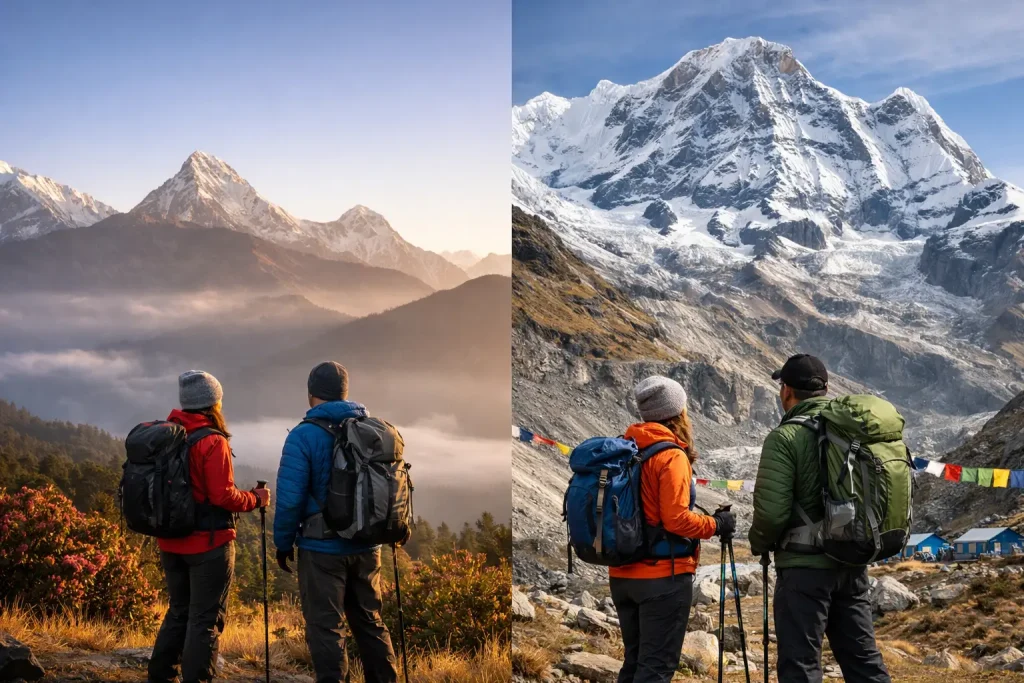
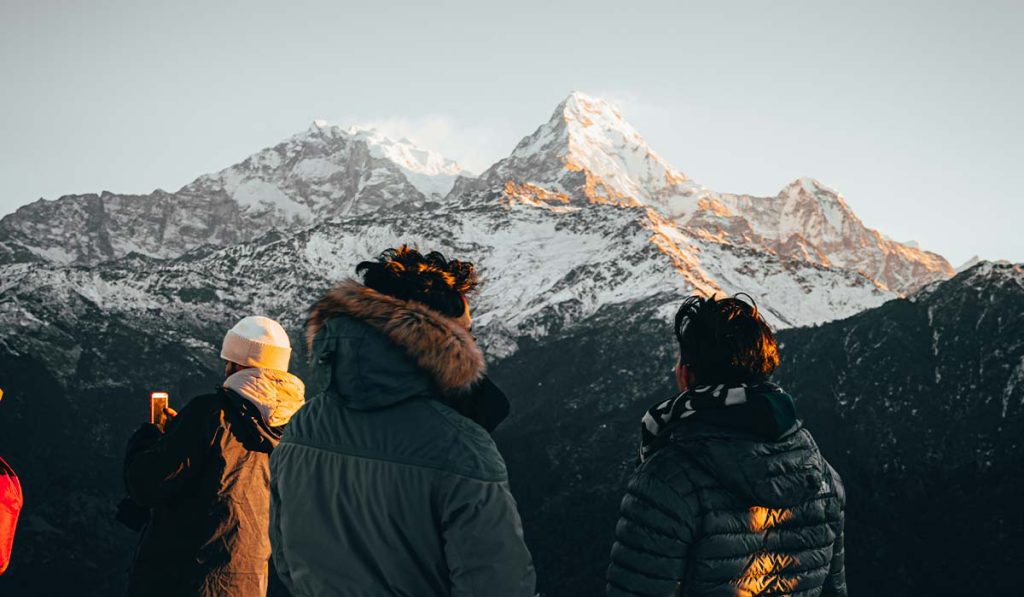
Poon Hill Trek is one of the best trips to view the Himalayan mountains. If you wake up early for the Poon Hill sunrise, the reward is not just one famous peak. The mountains visible from Poon Hill include a wide sweep of the Annapurna and Dhaulagiri ranges, and that broad Himalayan panorama is the real reason this short trek remains one of Nepal’s most satisfying viewpoints.
At around 3,210 meters, Poon Hill is high enough to give you an open horizon but still accessible for trekkers who may not want a long, high-altitude expedition. That balance is what makes it special. You get a dramatic mountain amphitheater without needing technical climbing, remote camping, or many days above extreme altitude.
Why Poon Hill Is Such a Famous Viewpoint
Poon Hill sits above Ghorepani in the Annapurna region and faces one of the finest mountain walls in Nepal. Unlike some viewpoints that frame a single dominant summit, Poon Hill gives you layered mountain geography. You see massive peaks, connecting ridgelines, glacier-shaped valleys, and changing colors across a long section of the Himalayas.
That matters for trekkers because the experience is more than checking off one mountain name. On a clear morning, you can understand the scale of the central Himalaya in a way that photos rarely capture. Peaks rise in groups, some sharp and icy, others broad and snow-covered, with different heights and distances creating real depth.
Mountains Visible from Poon Hill
The exact view depends on cloud cover, season, and light, but several mountains are commonly visible from Poon Hill and form the core of the panorama.
Dhaulagiri
Dhaulagiri, at 8,167 meters, is usually one of the most striking mountains in the view. It stands to the west and often appears huge, cold, and commanding, especially in the first light of day. Because it is one of the world’s 8,000-meter peaks, many trekkers are surprised that such a short trek offers such a strong view of a mountain of this scale.
The Dhaulagiri massif often looks broad rather than needle-like. In clear conditions, its sheer bulk is hard to miss. For many people on Poon Hill, Dhaulagiri becomes the mountain they remember most.
Annapurna South
Annapurna South is another major feature of the skyline and one of the easiest peaks to identify from Poon Hill. It rises prominently and helps define the classic Annapurna-side view. During sunrise, the snow catches warm orange and pink tones, making it one of the most photogenic peaks in the panorama.
For trekkers doing the Ghorepani Poon Hill route as a shorter Himalayan introduction, Annapurna South often becomes the visual anchor of the experience.
Annapurna I
Annapurna I, the highest peak in the Annapurna range at 8,091 meters, can also be seen from Poon Hill, though not always as dramatically isolated as some first-time visitors expect. It sits deeper in the range, and depending on conditions and your viewing angle, it may appear partly integrated into the broader mountain wall.
Still, seeing Annapurna I from such a relatively accessible trekking viewpoint is a major highlight. It adds serious Himalayan scale to the panorama.
Machhapuchhre
Machhapuchhre, also called Fishtail Mountain, is one of the most recognizable peaks in Nepal. Its sharp, elegant shape makes it stand out immediately. From Poon Hill, it is not always the largest mountain in the scene, but it is often the most distinctive.
Because of its sacred status and unclimbed reputation, Machhapuchhre carries a special presence. Many trekkers identify it first, even before learning the names of the broader Annapurna peaks around it.
Hiunchuli
Hiunchuli sits near Annapurna South and is commonly visible in the eastern part of the panorama. It is not always the first peak people name, but it contributes strongly to the overall mountain wall. In good light, its snowy slopes and connected ridges help build the depth of the Annapurna massif.
Nilgiri
Nilgiri is another important peak often visible from Poon Hill. It lies toward the Kali Gandaki side and adds to the broad western section of the view. Depending on weather and visibility, Nilgiri can appear very clear and well-defined, especially in autumn.
Other Peaks and Ridge Systems
On especially clear days, trekkers may also make out nearby supporting peaks and ridgelines connected to the Annapurna and Dhaulagiri systems. The full panorama can feel wider than expected, which is why local guides often help point out individual summits. Without that context, some peaks blend into one enormous snowy horizon.
What Makes the View Different From Other Treks
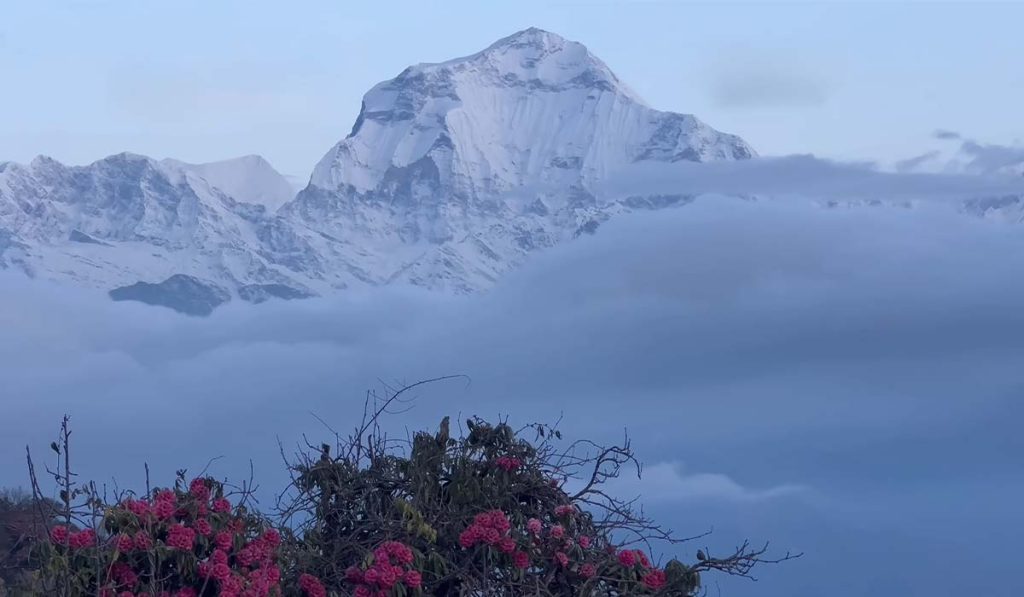
Poon Hill is not the closest viewpoint to the highest mountains in Nepal, and that is actually part of its strength. The distance gives you perspective. Instead of looking straight up at one mountain, you see multiple giant peaks arranged across a wide skyline.
This is very different from tighter valley views on some trekking routes, where the mountains can feel hidden until a turn in the trail opens the scene. At Poon Hill, the viewpoint itself is the event. You climb in darkness, arrive before sunrise, and then watch the entire range reveal itself gradually.
That sequence matters. Before sunrise, the peaks often appear as dark silhouettes. Then the first light hits the higher summits. A few minutes later, the ridges, glaciers, and lower slopes become more defined. If the weather is stable, the mountains keep changing for quite a while after the sun comes up.
Best Time for Clear Mountain Views at Poon Hill
If your main goal is to see the mountains visible from Poon Hill as clearly as possible, season matters a lot.
Autumn, from late September to November, is usually the best period for sharp mountain views. The skies are often clean after the monsoon, and visibility tends to be excellent. This is the season when the peaks look especially crisp and the sunrise conditions are often at their best.
Spring, from March to May, is also very good. The weather is generally stable, and the hills below are greener, with rhododendron forests often in bloom. The trade-off is that haze can sometimes build more quickly than in autumn, especially later in the morning.
Winter can also offer beautiful views, particularly on cold, clear mornings. The benefit is strong visibility and fewer trekkers. The downside is colder temperatures, possible frost or snow on the trail, and less comfort before dawn.
Monsoon season is the least reliable for mountain views. Clouds, rain, and poor visibility often block the panorama, though occasional breaks can still surprise you.
Sunrise or Daylight: When Is the Best View?
Most trekkers go to Poon Hill for sunrise, and for good reason. The early light creates the classic Himalayan color change that makes the viewpoint famous. Peaks like Dhaulagiri, Annapurna South, and Machhapuchhre can glow dramatically when the sun first touches them.
That said, sunrise is not automatically the clearest moment every day. Sometimes clouds move fast, and the view improves 20 to 40 minutes later. If conditions allow, it is worth staying on the hill a bit longer instead of leaving right after the first photos.
Trekkers who rush back too soon sometimes miss the clearest mountain definition of the morning.
Can You Identify Every Peak Yourself?
Probably not, at least not on a first visit. The panorama is broad, and several snowy peaks overlap visually. Many trekkers know the names Dhaulagiri, Annapurna, and Machhapuchhre, but distinguishing secondary summits can be harder in the field.
A local guide adds real value here. Good guides do more than point and name. They explain which peaks belong to which range, how the valleys separate them, and why some mountains look larger even when they are not the highest in the group. That kind of interpretation makes the viewpoint more meaningful.
Tips for Getting the Best Mountain View
A few practical choices can make a big difference. Stay overnight in Ghorepani so you can start early without stress. Leave enough time to reach the top before dawn, especially if the trail is crowded in peak season. Carry a warm layer, gloves, and a headlamp because pre-sunrise temperatures can feel sharp even in spring.
It also helps to keep your expectations realistic. Weather in the Himalayas is never guaranteed. Even during the best months, clouds can block some peaks. But when the sky opens, the mountain panorama from Poon Hill fully justifies the early wake-up.
For many trekkers, this viewpoint works so well because it is achievable. You do not need to be an elite mountaineer to stand in front of Dhaulagiri, Annapurna South, Machhapuchhre, and the rest of the great Himalayan skyline. You just need decent preparation, a clear morning, and the willingness to climb before sunrise.