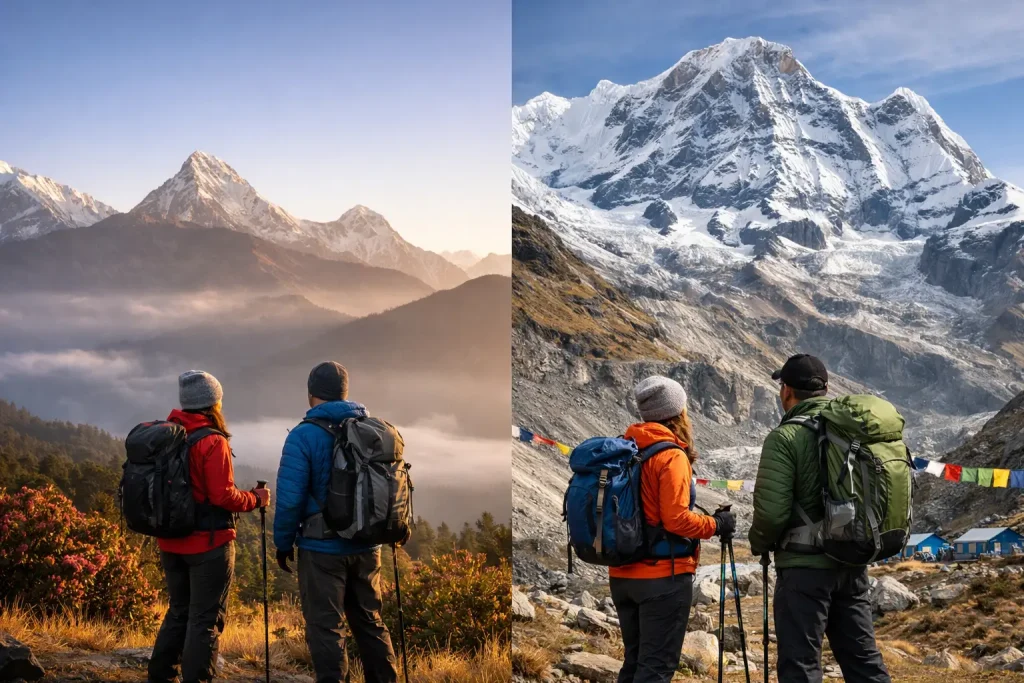
A lot of trekkers reach Poon Hill, watch the sunrise, take a few quick phone photos, and come back disappointed. The view is world-class, but the light changes fast, the crowd can get thick, and if you arrive unprepared, the best moment is gone in minutes. This Photography Guide to Poon Hill is for trekkers who want more than a basic souvenir shot and would rather return with images that actually reflect what the morning feels like in the Annapurna region.
Poon Hill trek is one of the most accessible mountain viewpoints in Nepal, and that is exactly why photographing it well takes some planning. The short pre-dawn climb from Ghorepani makes it possible for many trekkers, including beginners, to reach a major Himalayan panorama without a technical expedition. But easy access also means many photographers are standing in the same place at the same time, aiming at the same peaks. The difference between an average image and a strong one usually comes down to timing, lens choice, weather awareness, and where you position yourself before the sun hits the summits.
Why Poon Hill is so rewarding for photography
Poon Hill sits at about 3,210 meters and gives a broad amphitheater view of some of Nepal’s most famous mountains. On a clear morning, you can photograph Dhaulagiri, Annapurna South, Machhapuchhre, Hiunchuli, Nilgiri, and several surrounding peaks in one sweeping frame. Few trekking viewpoints offer this kind of scale with such a relatively short approach.
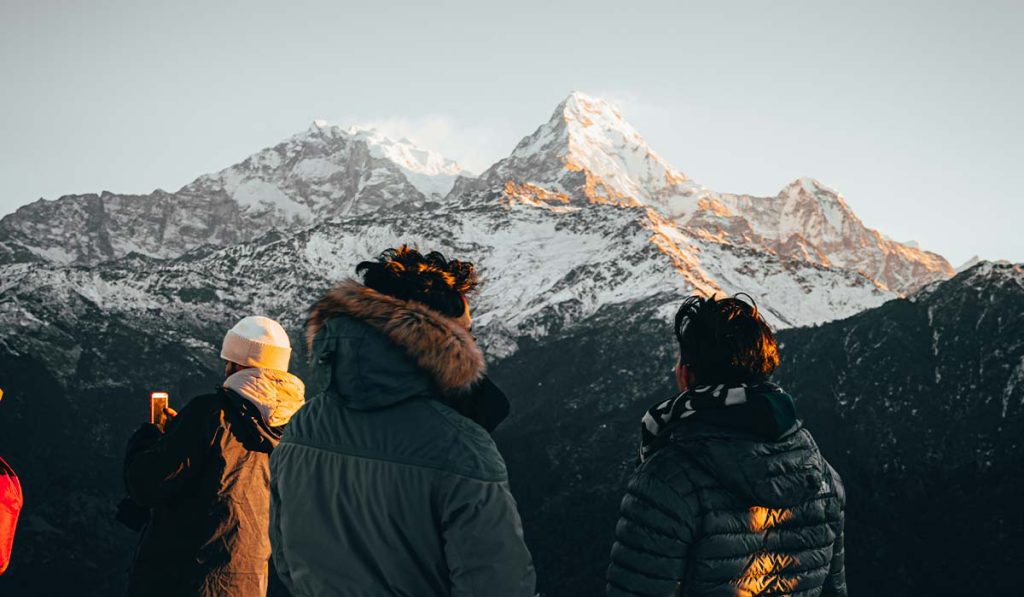
What makes it especially attractive for photographers is the way the light arrives. Before sunrise, the mountains often sit in a cold blue tone while the horizon starts to warm. Then the first direct sunlight touches the high peaks, creating that brief golden alpenglow stage many trekkers come for. After that, contrast increases quickly. If you know how to work through each phase, you can come away with a varied set of images rather than one rushed sunrise shot.
Best time of year for a Photography Guide to Poon Hill trip
Autumn and spring are the strongest seasons for photography at Poon Hill, but they produce different results.
Autumn, especially from late October to early December, usually brings the cleanest mountain visibility. The monsoon dust has settled, skies are often stable, and the long views are at their sharpest. If your priority is crisp mountain detail and reliable panoramas, this is usually the safer choice.
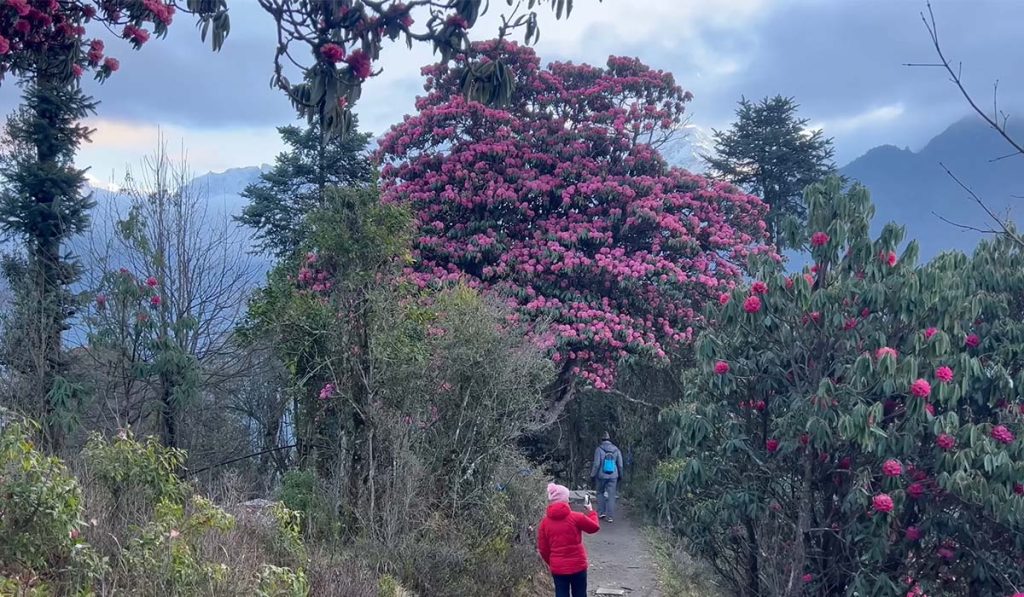
Spring, particularly March to April, adds a different mood. Rhododendron forests around the trail can be in bloom, which gives you much more than summit photography. The approach itself becomes photogenic, and you can mix mountain shots with forest color, village scenes, and textured landscape frames. The trade-off is that spring haze can sometimes soften the far peaks, especially later in the morning.
Winter can also be rewarding if the weather is clear. Snow on the trail and surrounding ridges can add drama, and the air can be very clean. The downside is obvious – colder starts, possible ice on the climb, and more demanding battery management for cameras and phones.
Monsoon season is the least reliable. You may get atmospheric clouds and moody scenes, but the classic mountain panorama is often hidden. If your main goal is the iconic sunrise over the Annapurna and Dhaulagiri ranges, the monsoon is a gamble.
When to leave Ghorepani for the best light
The biggest mistake trekkers make is leaving too late. From Ghorepani, the uphill walk to Poon Hill usually takes around 45 minutes to an hour, depending on pace, crowd, fitness, and trail conditions. For photography, reaching the viewpoint just before sunrise is not enough. You want time to settle in, check your composition, and photograph the pre-sunrise color.
A better approach is to arrive at least 30 to 45 minutes before official sunrise. That gives you time for three useful shooting windows: the blue hour before dawn, the first warm color on the horizon, and the moment sunlight begins touching the peaks. These stages can look very different, and some of the best images happen before the sun itself appears.
If the forecast is clear, start earlier than you think you need to. If the trail is busy, you may also lose time overtaking slower groups in the dark. A headlamp is essential, and it helps to prepare your camera settings the night before rather than fumbling with them in the cold.
Best compositions at Poon Hill
Most people point their camera straight at the brightest peaks and stop there. That works, but it often creates the same image everyone else gets. Poon Hill gives better options if you slow down.
Wide landscape frames are the obvious starting point. They work well when the entire range is visible and the sky has color. A lens in the wide to standard range is usually enough for this. If you can include a little foreground, such as the slope, prayer flags, or the shape of the viewpoint, the image often feels more grounded.
A medium telephoto lens is useful for isolating light on individual summits, especially Dhaulagiri and Annapurna South. This is often where the strongest sunrise work happens because the first sunlight can create selective contrast on ridges and snow faces. You do not always need the full panorama.
Human scale can improve the frame when used carefully. A trekker standing still, looking toward the peaks, can help show the size of the landscape. The key is restraint. If the foreground gets too crowded or distracting, the mountains lose impact.
Do not ignore the trail, the villages, and the forests below. Ghorepani, Ulleri, Banthanti, and the stone steps along the route offer strong documentary and travel photography opportunities. Early morning smoke from lodges, local life, mule trains, terraced hillsides, and rhododendron woods can build a more complete visual story than sunrise alone.
Camera gear that makes sense on the trek
You do not need a heavy professional kit to photograph Poon Hill well. In fact, carrying too much gear on a short but steep trek often becomes a burden.
A practical setup is one camera body with a wide-to-medium zoom and, if you are serious about mountain details, a compact telephoto. Many trekkers do well with something in the rough range of 24-70mm plus 70-200mm equivalent. If you prefer to travel lighter, a single versatile zoom is enough for most situations.
A tripod helps in low light before sunrise, especially if you want cleaner files at a lower ISO. But it is not mandatory. If the viewpoint is crowded, a large tripod can become inconvenient for both you and others. A lightweight travel tripod is the better choice.
Bring spare batteries and keep them warm inside your jacket before use. Cold mornings drain power faster than many trekkers expect. A lens cloth also matters more than people think, especially if there is frost, moisture, or dust on the lens.
If you are using a phone, arrive early, stabilize yourself well, and avoid relying too much on digital zoom. Phones can do very well at Poon Hill if visibility is clear and composition is thoughtful.
Settings and field technique for sunrise
At Poon Hill, exposure changes quickly. If you shoot only in auto mode, your camera may struggle as bright sky and dark foreground compete. If you are comfortable with manual or aperture priority mode, use them.
For wide landscapes, start with a mid-range aperture like f/8 or f/11 for good depth and sharpness. Keep ISO as low as conditions allow. Before sunrise, you may need slower shutter speeds, which is where a tripod helps. Once the first sunlight appears, shutter speeds rise quickly and handholding becomes easier.
Watch your highlights. Snow peaks can lose detail fast when direct sun hits them. It is often better to expose slightly for the bright mountains and lift shadows later than to blow out the snow texture. If your camera allows it, checking the histogram is useful.
Bracketing can help in high-contrast scenes, but do not spend the whole sunrise buried in settings. Conditions change by the minute. A simple, responsive workflow usually works best here.
Weather realities and what they mean for photos
Mountain weather does not always match the forecast exactly. A clear evening in Ghorepani improves your chances, but it does not guarantee a perfect sunrise. Clouds can move in overnight, and morning haze can flatten distant ridges.
That said, partial cloud is not always bad. Some of the most memorable Poon Hill photos come when gaps in the clouds let shafts of light break across the range. A completely blank white cloud is disappointing, but mixed weather can create depth and drama.
If visibility is poor at sunrise, keep shooting selectively. Mist in the forest, silhouettes of trekkers, or layered hill contours can still produce worthwhile images. Good mountain photography often depends on adapting, not forcing one’s expected shot.
Practical trekking advice that helps photographers
Photographing Poon Hill starts before you raise the camera. Sleep, hydration, and simple preparation matter because the climb begins in darkness and cold. Lay out your warm layers, gloves, headlamp, batteries, and camera the night before. Even small delays at 4:30 a.m. can cost you the best light.
If you are trekking independently, ask your lodge about recent sunrise conditions and trail timing. Local advice is often more useful than a generic weather app. If you are trekking with a guide, use that advantage. A good guide can help you leave at the right time, avoid unnecessary rush, and understand what conditions are normal for the season.
Respect the viewpoint space. During peak trekking months, Poon Hill can be crowded, and photographers sometimes create problems by blocking sightlines or spreading gear too widely. Work efficiently and be aware of others. You will still get better images by arriving early and staying calm than by trying to control the whole platform.
A Photography Guide to Poon Hill is really about timing and patience
Poon Hill is not difficult to reach, but it rewards photographers who treat the morning seriously. The best images usually come from arriving early, carrying a simple kit, watching the light closely, and staying open to more than one kind of shot. If the peaks glow clearly, you will understand why this viewpoint remains one of Nepal’s classic short-trek rewards. If the weather shifts, the landscape still offers texture, people, and atmosphere worth photographing. Go up ready, not rushed, and the mountain will usually give you something honest to bring home.