One dead phone can turn a simple trek problem into a real headache. On the Pikey Peak trail, power is available in many villages, but it is not something you should assume will be reliable every night. If you are wondering about Electricity and Charging Facilities on the Pikey Peak route, the short answer is this: charging is usually possible at teahouses, but availability, speed, and cost depend on the village, season, weather, and local power setup.
Pikey Peak trek is one of the more accessible trekking routes in lower Everest region, and that helps when it comes to basic infrastructure. Compared with remote camping routes or higher-altitude trails deep in the mountains, you have a better chance of finding charging points in lodges along this trek. Still, “available” does not always mean “convenient.” Some places have grid electricity, some rely partly on solar, and some may limit charging during cloudy days or heavy lodge demand.
How reliable is electricity on the Pikey Peak route?
In the main overnight stops on the Pikey Peak trek, electricity is commonly available in some form. Villages such as Dhap, Jhapre, Pikey Base Camp area lodges, Junbesi, and Phaplu generally have lodges that can offer charging, especially during the main trekking seasons. That said, reliability changes from place to place.
In lower villages, power is often more dependable because access is easier and infrastructure is better than on very remote Himalayan trails. Once you move higher, especially around more exposed or smaller stops, charging may be slower, limited to certain hours, or dependent on solar backup. If several trekkers reach the same lodge in the evening, available sockets can quickly become scarce.
This is why experienced trekkers do not plan around the assumption that they will fully recharge everything every night. On Pikey Peak, power is usually there, but flexibility matters.
Where can you usually charge devices?
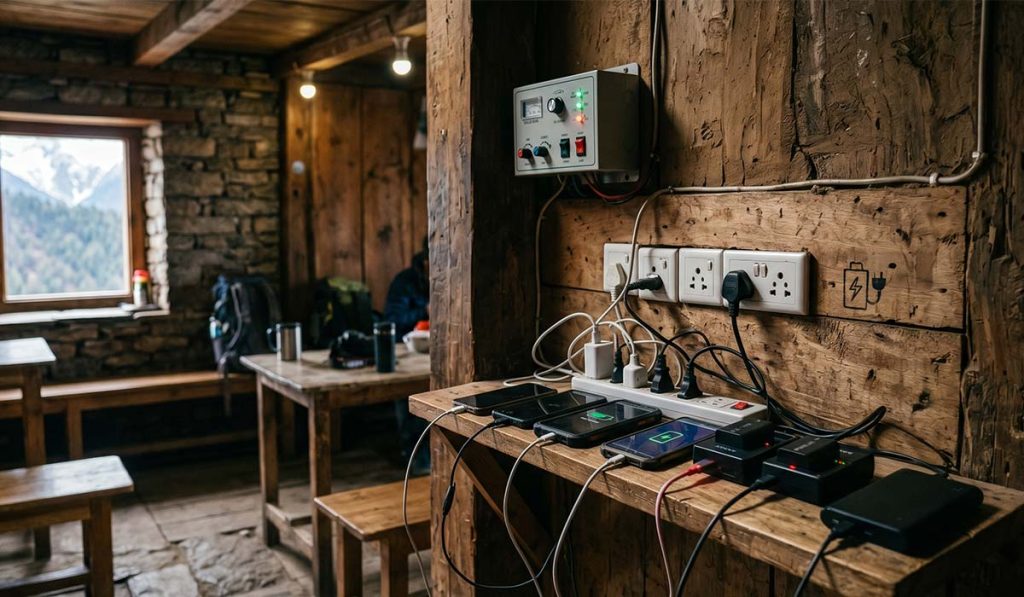
Most trekkers will be able to charge phones, cameras, smartwatches, headlamps, and power banks at teahouses where they spend the night. Charging is not typically available out on the walking trail itself, so your evening lodge stop is the practical window.
At lower elevations and in larger settlements, charging may happen in the dining hall, reception area, or sometimes even in rooms. On many Nepal treks, room charging is less common than shared-area charging, and Pikey Peak follows a similar pattern. A lodge owner may ask you to leave your phone or power bank at the counter or plug it into a shared extension board near the stove.
That setup is normal, but it also means you should carry your own charger, cable, and a bit of patience. If you use multiple devices, it helps to prioritize what really needs charging first.
Electricity and Charging Facilities on the Pikey Peak route by stop
The exact lodge and power situation can change, but a general pattern is useful for planning.
Dhap, where many treks begin, usually offers the most comfortable charging access of the route’s early stages. Because it is a road-connected entry point, power tends to be easier to find here than at higher, smaller stops.
Jhapre also commonly has charging facilities in local lodges. This is a good place to top up devices before heading higher. If the weather is poor or lodge occupancy is high, charging may be slower, but it is usually available.
Around Pikey Base Camp or nearby overnight stops, electricity becomes a bit less predictable. Some lodges can still charge your devices without issue, while others may be more limited, especially if they depend on solar systems and the day has been cloudy. This is where backup power becomes most useful.
Junbesi, being a well-known Sherpa village on a broader trekking network, generally has better lodge infrastructure again. Many trekkers find charging easier here after the higher section of the route. Phaplu, if included in your itinerary, is another place where charging tends to be more dependable.
So the route does have charging opportunities throughout, but the higher and smaller the stop, the more cautious your expectations should be.
How much does charging cost?
Charging on Nepal trekking routes is often not free, and Pikey Peak is no exception. Some lodges may include basic charging in the room rate, especially in lower villages or less busy periods, but many charge separately per device or per hour.
You should expect a small fee for phones, camera batteries, or power banks. The amount varies by lodge, by season, and by how the power is generated. Solar-dependent lodges or those in higher areas are more likely to charge extra, since electricity there is a limited resource rather than a simple utility.
A useful habit is to ask before plugging anything in. That avoids confusion later and helps you manage your cash. On routes like Pikey Peak, small logistical costs add up, and charging fees are one of those details many trekkers forget to budget for.
What devices are easiest to charge?
Phones are the simplest. Most teahouses can handle phone charging unless there is a full outage or strong demand. Small USB-powered items such as smartwatches, GPS watches, and headlamps are also usually manageable.
Power banks are where you need to think ahead. A large-capacity power bank takes longer to charge than a phone, and some lodges may not want several high-demand devices plugged in at once. Camera batteries are generally fine, but only if you carry the proper charger and adapter.
Laptops, drones, and energy-hungry electronics are less practical on this trek. Even if power is available, lodge owners may be reluctant to support long charging times for large devices, or they may charge a noticeably higher fee.
The main problems trekkers run into
The most common issue is not a total lack of electricity. It is limited access at the exact time everyone wants it. Evenings are busy. Trekkers arrive, order tea, sit near the dining stove, and start looking for sockets. If a lodge has only one charging station, it can become crowded quickly.
Cold weather can also make your battery seem weaker than it really is. Phones and camera batteries drain faster in low temperatures, especially if kept in outer pockets. Many trekkers assume the route has poor electricity when the bigger issue is simply battery performance in the cold.
Another problem is slow charging. Shared extension boards, weak solar supply, and fluctuating power can all mean your phone gains much less charge than expected overnight. If you are tracking your route, taking frequent photos, or using your phone for reading and entertainment in the lodge, that gap becomes noticeable after a few days.
Best backup strategy for this trek
For Pikey Peak, the smartest approach is simple: bring one good power bank and treat lodge charging as support, not your only plan. A medium or high-capacity power bank is usually enough for this route, since the trek is relatively short compared with longer expeditions in Everest or Annapurna.
Keep your phone on airplane mode when you do not need a signal. Lower screen brightness. Turn off background apps. If you carry a camera, use it for photos instead of draining your phone all day. At night, keep electronics inside your sleeping bag or duffel under extra layers so cold temperatures do not reduce battery life.
A universal travel adapter is also worth carrying, along with your own charging cable in good condition. Lodge sockets can be limited, loose, or shared, so being able to connect matters quickly.
Should you carry a solar charger?
For most trekkers on the Pikey Peak route, a solar charger is optional rather than necessary. The trek is not so long or remote that solar becomes essential. In fact, during poor weather or short winter daylight, a small trekking solar panel may not perform as well as people expect.
A reliable power bank is usually the better solution. It is lighter, simpler, and more dependable for this particular route. Solar can help if you spend a lot of time outdoors in bright post-monsoon weather and know how to use it efficiently, but for the average trekker, it is not the first thing to invest in.
Practical advice before you start trekking
Charge every device fully before leaving Kathmandu or the trailhead. Do not begin the trek with half-full gear, thinking you will sort it out on the way. Once you are on the trail, top up whenever the opportunity is easy, especially in lower villages with better electricity.
Ask your guide or lodge owner early in the afternoon about charging options rather than waiting until after dinner. If you are trekking independently, this small habit helps you avoid the evening rush. If you are trekking with an operator such as Himalaya Wanderer, your guide can often help you understand where charging is likely to be easiest on your overnight stops.
It also helps to think realistically about your device use. If your goal is photos, maps, and basic communication, charging on Pikey Peak is usually enough with one backup power bank. If you plan to film constantly, run multiple batteries, or use your phone for everything, you will need stricter power management.
Pikey Peak is a rewarding trek because it gives you big mountain views without the long logistical strain of more demanding routes. Electricity on the trail is good enough for most trekkers, just not guaranteed in the way many travelers are used to at home. Plan for some limits, carry backup power, and you should have no trouble keeping your essential devices running.